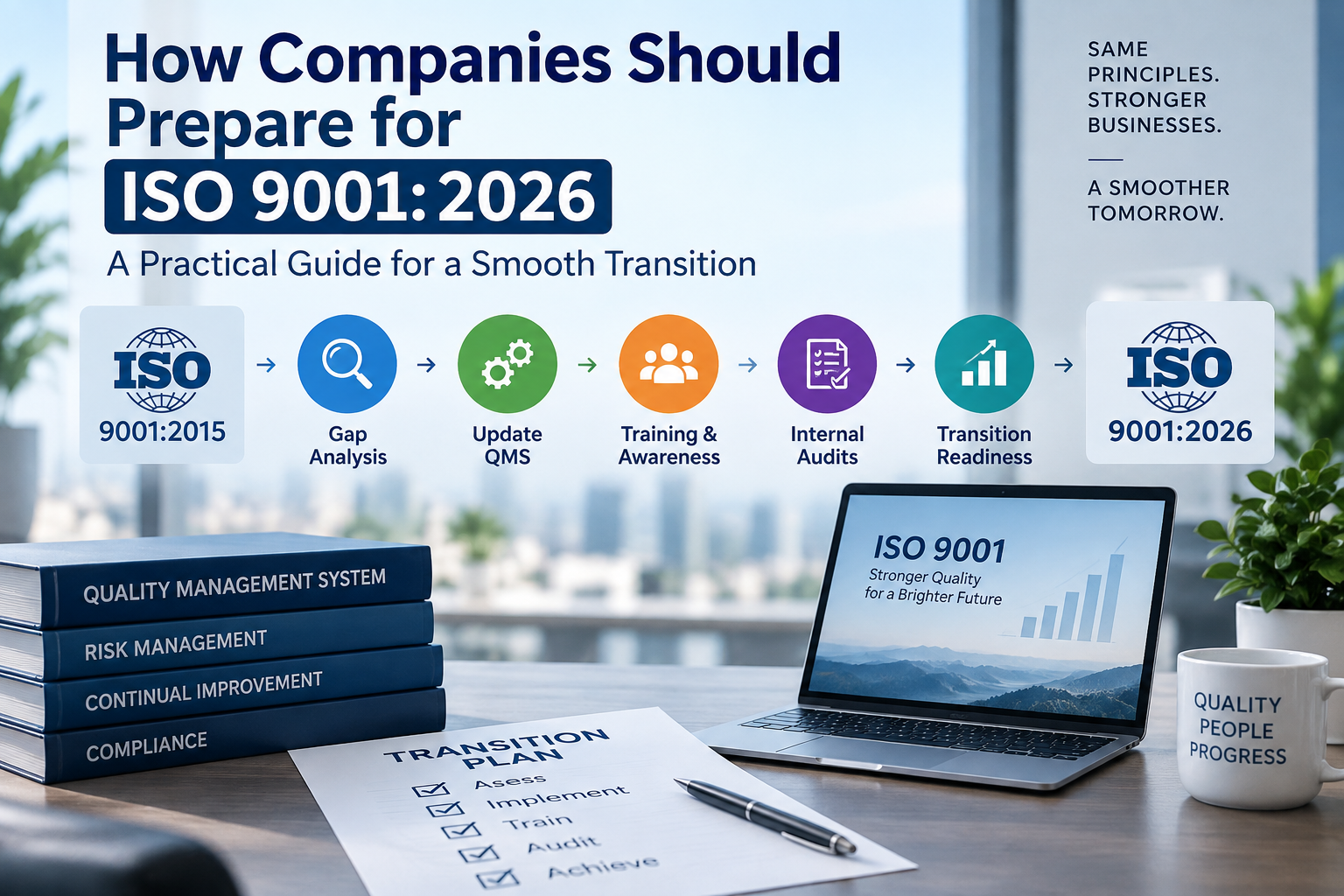
ISO 9001:2026 transition preparation should begin with a structured review of the revised Quality Management System requirements.
ISO 9001:2026 is approaching, and organizations currently using ISO 9001:2015 should begin preparing their Quality Management Systems for the transition.
Preparation does not mean rewriting the entire QMS. Organizations should first understand the revised requirements, evaluate their existing processes and identify specific areas where changes or improvements may be required.
A structured ISO 9001 transition plan can help companies avoid unnecessary documentation, reduce last-minute corrective actions and ensure that employees, process owners and management are prepared for the revised standard.
This guide explains practical steps companies can take to prepare for ISO 9001:2026 and achieve a smooth and effective transition.
Table of Contents
Why Companies Should Start Preparing for ISO 9001:2026
Organizations that prepare early for ISO 9001:2026 will have more time to understand the revised requirements, assess their existing Quality Management System and implement necessary improvements in a controlled manner.
Waiting until immediately before a transition or certification audit can create unnecessary pressure, rushed documentation updates and ineffective implementation.
Early preparation also gives organizations sufficient time to involve top management, process owners and internal auditors, provide relevant awareness or training and verify changes through internal audits.
The objective should be a planned transition that improves QMS effectiveness rather than simply making changes to satisfy an audit.
For official information and updates regarding ISO 9001, refer to the International Organization for Standardization (ISO).
Step 1: Understand the ISO 9001:2026 Changes
The first step is to understand what has changed between ISO 9001:2015 and ISO 9001:2026 and determine how those changes may affect the organization’s existing Quality Management System.
Companies should review the revised requirements carefully and pay particular attention to areas receiving greater emphasis, including leadership involvement, quality culture, risks and opportunities, and clearer interpretation of requirements.
The review should involve relevant process owners rather than being handled only by the Quality Department. Each department should understand which changes are relevant to its processes and responsibilities.
Organizations should avoid making immediate changes based only on assumptions. First understand the requirement, compare it with the existing QMS and then determine whether an actual improvement or update is necessary.
Step 2: Conduct an ISO 9001:2026 Gap Analysis
A structured gap analysis helps organizations compare their existing ISO 9001:2015 Quality Management System with the revised ISO 9001:2026 requirements.
The assessment should review relevant processes, procedures, documented information, responsibilities, risks and opportunities, performance monitoring and existing management controls.
Each identified gap should be clearly documented together with the required action, responsible person, target completion date and implementation status.
Organizations should focus on genuine compliance and effectiveness gaps rather than creating unnecessary documents simply to demonstrate that a transition activity has been completed.
The gap analysis results should become the foundation for the organization’s ISO 9001:2026 transition action plan.
Step 3: Develop an ISO 9001:2026 Transition Action Plan
After completing the gap analysis, organizations should convert the identified gaps into a clear and manageable transition action plan.
Each action should define what needs to be changed, who is responsible, the target completion date and how effective implementation will be verified.
Actions may include updating affected processes or documented information, strengthening risk and opportunity controls, improving leadership involvement, providing employee awareness and training, or improving monitoring and performance evaluation.
Priority should be given to changes that have a significant impact on QMS effectiveness, customer requirements or organizational performance.
Transition progress should be reviewed regularly so that delays, resource requirements and implementation issues can be addressed before the transition audit.
Step 4: Review and Update QMS Documentation
Organizations should review their existing QMS documentation to determine whether any updates are required to align with ISO 9001:2026.
This may include policies, procedures, process maps, work instructions, risk registers, objectives, forms and other documented information affected by the revised requirements.
Companies should avoid rewriting documents that remain effective and compliant. Documentation should only be updated where a genuine gap, changed requirement or improvement opportunity has been identified.
All revised documents should be properly reviewed, approved, communicated and controlled in accordance with the organization’s documented information process.
The objective is to maintain a practical and effective QMS rather than increasing documentation unnecessarily.
Step 5: Strengthen Leadership and Quality Culture
Leadership involvement plays an important role in ensuring that the Quality Management System supports the organization’s strategic direction and business objectives.
Top management should actively participate in QMS performance reviews, provide necessary resources, support quality objectives and ensure that quality responsibilities are understood throughout the organization.
Companies should also strengthen their quality culture by encouraging employees to take responsibility for quality, report problems, identify improvement opportunities and understand how their work affects customers and overall performance.
Quality should not be treated only as the responsibility of the Quality Department. An effective quality culture requires involvement from leadership, process owners and employees across all functions.
Organizations should use the ISO 9001:2026 transition as an opportunity to strengthen this involvement and integrate quality more effectively into everyday business activities.
Step 6: Review Risks and Opportunities
Organizations should review how risks and opportunities are identified, evaluated and addressed within their existing Quality Management System.
The review should consider risks that could affect product or service quality, customer satisfaction, process performance, supplier performance and the organization’s ability to achieve intended QMS results.
Relevant opportunities should also be considered, such as process improvement, automation, digitalization, employee development, improved supplier controls and more effective monitoring methods.
Risk and opportunity actions should be practical and proportionate to their potential impact. Organizations should avoid creating unnecessary documentation that does not contribute to effective decision-making.
The effectiveness of actions taken should be monitored and reviewed as part of normal QMS performance evaluation and management activities.
Step 7: Train Employees and Internal Auditors
Employees should understand the ISO 9001:2026 changes that are relevant to their roles, processes and quality responsibilities.
Organizations should provide appropriate awareness or training to process owners, supervisors and employees so they understand any updated controls, responsibilities or working practices.
Internal auditors should receive specific training on the revised requirements before conducting transition-related audits. They should be able to evaluate both conformity and the effectiveness of implementation.
Training effectiveness should also be verified through practical implementation, employee understanding, audit results or other appropriate evaluation methods.
The objective is not simply to complete training records, but to ensure that people can effectively apply the revised QMS requirements in their daily activities.
Step 8: Conduct an Internal Audit Against ISO 9001:2026
Before the transition audit, organizations should conduct an internal audit to evaluate whether the relevant ISO 9001:2026 requirements have been effectively implemented.
The audit should cover affected processes, updated controls, documented information, risks and opportunities, leadership involvement and other areas identified during the gap analysis.
Internal auditors should focus on objective evidence and actual process effectiveness rather than checking documentation alone.
Any nonconformities or improvement opportunities identified during the audit should be investigated, corrected and followed through with appropriate corrective actions where required.
Completing an effective internal audit before the transition audit gives the organization an opportunity to identify and address remaining gaps in advance.
Step 9: Conduct Management Review for Transition Readiness
Management review should be used to evaluate the organization’s overall readiness for the ISO 9001:2026 transition.
Top management should review the status of transition actions, gap analysis results, internal audit findings, identified risks and opportunities, resource requirements and any remaining implementation issues.
The review should also consider whether updated QMS processes are achieving their intended results and whether additional actions, resources or training are required.
Any decisions and actions resulting from the management review should be clearly recorded, assigned and followed through to completion.
This provides management with objective evidence of transition readiness before the organization proceeds with its external transition audit.
Step 10: Coordinate with Your Certification Body
Organizations should communicate with their certification body to understand the applicable transition arrangements for moving from ISO 9001:2015 to ISO 9001:2026.
Companies should confirm when their transition audit can be conducted, whether additional audit time may be required and what information the certification body expects before the audit.
Organizations should also confirm how the transition will align with their existing surveillance or recertification audit schedule.
Certification arrangements should be based on official transition guidance rather than assumptions, particularly while final implementation requirements are being established.
Early coordination can help organizations plan resources, avoid scheduling issues and complete the transition within the applicable timeframe.
ISO 9001:2026 Transition Readiness Checklist
Before proceeding with the ISO 9001:2026 transition, organizations should verify that:
✓ ISO 9001:2026 changes have been reviewed and understood.
✓ A gap analysis has been completed against the existing QMS.
✓ Identified gaps have clear actions, responsibilities and target dates.
✓ Relevant QMS documents and processes have been updated where necessary.
✓ Leadership and process owners are actively involved in the transition.
✓ Risks and opportunities have been reviewed and appropriate actions implemented.
✓ Relevant employees have received appropriate awareness or training.
✓ Internal auditors understand the revised requirements.
✓ An internal audit has verified implementation and effectiveness.
✓ Management review has evaluated transition readiness.
✓ Identified nonconformities and corrective actions have been addressed.
✓ Transition arrangements have been confirmed with the certification body.
A documented readiness review can help organizations identify any remaining gaps before proceeding with the external transition audit.
Common Mistakes Companies Should Avoid During ISO 9001:2026 Preparation
Companies should avoid treating the ISO 9001:2026 transition as only a documentation exercise. Updating procedures without ensuring effective implementation may create compliance gaps during audits.
Another common mistake is rewriting the entire Quality Management System without first conducting a gap analysis. Existing processes that remain effective should be retained wherever appropriate.
Organizations should also avoid leaving transition activities until shortly before the external audit, as this may result in rushed training, incomplete corrective actions and insufficient time to verify effectiveness.
Other mistakes include excluding process owners from transition planning, providing inadequate employee awareness, focusing only on audit preparation and failing to involve top management.
A structured and evidence-based approach helps organizations focus resources on genuine gaps and achieve a more effective transition.
How QMS Cert Services Can Support Your ISO 9001:2026 Preparation
QMS Cert Services supports organizations in preparing their Quality Management Systems for the transition to ISO 9001:2026 through a practical and structured approach.
Our support can include ISO 9001 gap analysis, QMS documentation review, process assessment, risk and opportunity evaluation, internal audit support, corrective action guidance, management review preparation, employee awareness and transition readiness assessment.
We focus on identifying genuine gaps and improving QMS effectiveness rather than creating unnecessary documentation or making changes that do not add value.
Whether your organization already maintains an established ISO 9001:2015 system or requires additional support for transition preparation, QMS Cert Services can help develop a practical action plan based on your organization’s processes and requirements.
For ISO 9001:2026 transition support, contact QMS Cert Services to discuss your organization’s requirements.
Conclusion
Preparing for ISO 9001:2026 should be a planned improvement process rather than a last-minute certification exercise.
A well-planned ISO 9001:2026 transition can help organizations implement the revised requirements systematically while maintaining the effectiveness of their existing QMS.
Organizations should begin by understanding the revised requirements, conducting a structured gap analysis and developing a clear transition action plan. Relevant QMS documentation, risks and opportunities, employee competence, internal audits and management review should then be evaluated and updated where necessary.
Companies with an effective ISO 9001:2015 Quality Management System should focus on genuine gaps instead of rebuilding their entire QMS.
Early preparation, strong leadership involvement and effective verification can help organizations achieve a smoother transition while strengthening overall QMS performance and continual improvement.