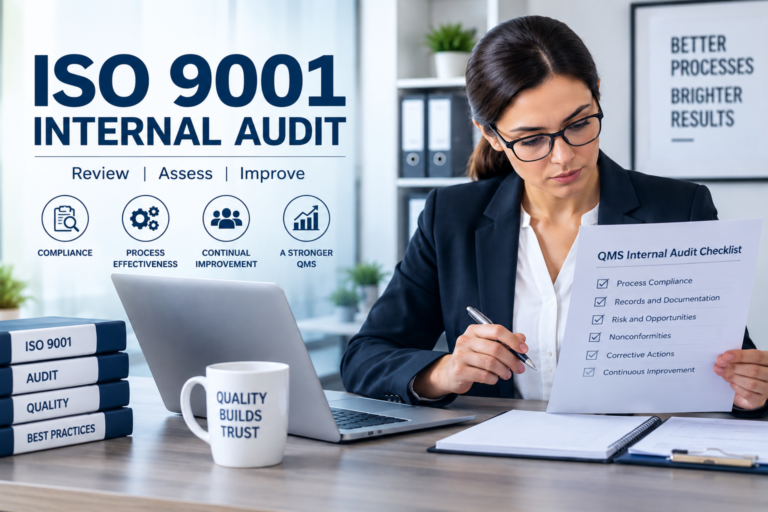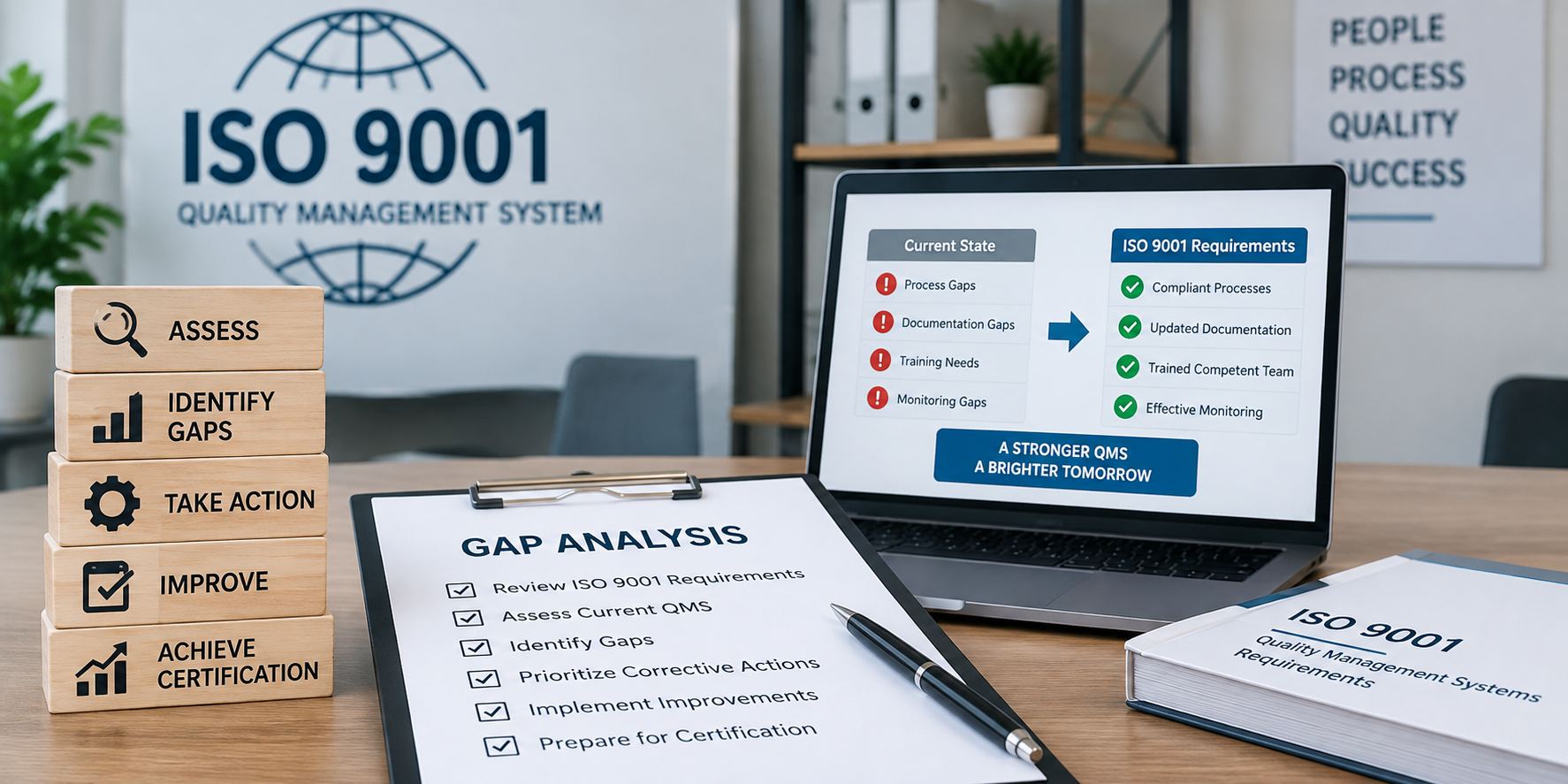
ISO 9001 gap analysis is a systematic assessment used to compare an organization’s existing Quality Management System (QMS) against the requirements of ISO 9001. It helps identify what is already compliant, what needs improvement and what actions are required before certification or an external audit.
A properly conducted gap analysis can prevent organizations from spending time and resources on unnecessary documentation. Instead, it provides a clear picture of existing weaknesses and helps management prioritize actions based on actual compliance gaps and business risks.
This guide explains how to conduct an ISO 9001 gap analysis, what areas should be reviewed, common gaps found in organizations and how to convert the findings into an effective implementation action plan.
Table of Contents
What Is an ISO 9001 Gap Analysis?
An ISO 9001 gap analysis is a structured review of an organization’s existing processes, controls and documented information against the requirements of ISO 9001.
The purpose is to determine the current level of conformity and identify areas where requirements are missing, partially implemented or ineffective.
A gap analysis is commonly conducted before implementing ISO 9001, preparing for certification, transitioning to a revised edition of the standard or improving an existing Quality Management System.
The result should provide management with a clear understanding of the gaps, their significance and the actions required to achieve an effective and compliant QMS.
Why Is ISO 9001 Gap Analysis Important?
An ISO 9001 gap analysis helps an organization understand its current QMS status before investing significant time and resources in implementation or certification activities.
Without a proper gap analysis, organizations may create unnecessary procedures, overlook important requirements or focus on documentation while actual process weaknesses remain unresolved.
A well-planned gap analysis can help identify compliance gaps early, establish implementation priorities, allocate resources effectively, reduce certification preparation time and improve overall QMS effectiveness.
It also provides management with a practical roadmap showing what needs to be corrected, improved or implemented before proceeding with the next stage of ISO 9001 implementation or certification.
When Should an Organization Conduct an ISO 9001 Gap Analysis?
Organizations can conduct an ISO 9001 gap analysis at different stages of their Quality Management System journey.
It is particularly useful before starting ISO 9001 implementation, before applying for certification, when preparing for a certification or surveillance audit, after significant organizational or process changes, and when transitioning to a revised edition of ISO 9001.
Organizations with an existing QMS may also conduct periodic gap analyses to identify weaknesses that routine internal audits or performance monitoring may not have fully addressed.
Conducting the assessment at the right time allows management to identify potential issues early and take corrective action before they develop into major audit findings or operational problems.
How to Conduct an ISO 9001 Gap Analysis
A systematic approach should be used when conducting an ISO 9001 gap analysis. The assessment should cover applicable ISO 9001 requirements as well as the organization’s actual processes and working practices.
The following steps provide a practical approach for conducting an effective ISO 9001 gap analysis.
1. Understand the ISO 9001 Requirements
Before identifying gaps, the person conducting the assessment should have a clear understanding of the applicable ISO 9001 requirements.
Each requirement should be reviewed in relation to the organization’s actual activities, processes, products, services and business risks.
The objective is not simply to check whether a procedure exists. The assessor should determine whether the required process is established, effectively implemented, understood by responsible personnel and supported by appropriate evidence.
This approach helps distinguish between a documentation gap and an actual implementation or process effectiveness gap.
2. Define the Scope of the Gap Analysis
Before starting the assessment, clearly define what will be included in the ISO 9001 gap analysis.
The scope may cover the entire organization or specific departments, locations, processes, products or services depending on the purpose of the assessment.
The assessor should identify relevant processes, responsible personnel, applicable documented information and interactions between departments.
A clearly defined scope helps ensure that important areas are not overlooked and allows the gap analysis to remain focused, structured and manageable.
3. Review Existing QMS Documentation
Review the organization’s existing Quality Management System documentation to determine whether it adequately supports the applicable ISO 9001 requirements and actual business processes.
Relevant documented information may include the Quality Policy, Quality Objectives, QMS scope, process maps, procedures, work instructions, forms, risk and opportunity registers, supplier evaluation records, inspection and testing records, calibration records, training records, internal audit reports and management review records.
The review should identify missing, outdated, duplicated or ineffective documentation.
However, the objective should not be to create documents simply to satisfy an audit. Documented information should provide practical value by supporting effective process control, consistency and evidence of conformity.
4. Interview Process Owners and Employees
A gap analysis should not be limited to reviewing documents. Interviews with process owners and employees help determine whether documented processes are actually understood and followed in daily operations.
Ask responsible personnel to explain their activities, responsibilities, process controls, quality objectives, risks, records and methods used to monitor performance.
Compare their responses with documented procedures and actual working practices.
Differences between documented processes and actual practices can indicate implementation gaps, training needs, unclear responsibilities or ineffective process controls.
5. Observe Actual Processes and Operations
Direct observation helps verify whether processes are being performed according to established requirements and controls.
The assessor should observe relevant operational activities such as production, inspection, testing, storage, purchasing, maintenance, calibration, product identification and handling of nonconforming outputs, depending on the organization’s activities.
Evidence should be compared with procedures, work instructions, records and employee explanations.
This helps identify practical gaps that may not be visible through document review alone, including uncontrolled practices, missing records, inadequate process controls or differences between documented and actual working methods.
6. Identify and Classify the Gaps
Each identified gap should be clearly documented and classified so that management can understand its significance and prioritize the required actions.
A practical classification may include compliant, partially compliant, non-compliant and opportunity for improvement.
Each gap should include the applicable requirement, objective evidence, description of the issue, responsible process or department and recommended action.
Higher-risk gaps that could affect product or service conformity, customer satisfaction, regulatory compliance or QMS effectiveness should receive priority.
Clear classification makes it easier to convert the gap analysis results into a structured and measurable implementation action plan.
7. Develop an ISO 9001 Gap Analysis Action Plan
Once the gaps have been identified, the organization should develop a structured action plan to address them.
The action plan should clearly define each required action, responsible person or department, target completion date, required resources and method for verifying completion.
Actions may include updating processes, revising documented information, providing employee training, improving operational controls, establishing missing records or strengthening monitoring and measurement activities.
Progress should be regularly reviewed by management to ensure that actions are completed effectively and identified gaps are properly closed before the certification or external audit.
ISO 9001 Gap Analysis Checklist
A practical ISO 9001 gap analysis checklist can help ensure that important QMS requirements and processes are systematically reviewed.
The checklist should be adapted to the organization’s size, activities, products, services and QMS scope. Key areas to assess include organizational context, leadership, planning, support, operations, performance evaluation and improvement.
The following areas should be considered during the assessment:
Organizational Context and QMS Scope
Review whether the organization has identified relevant internal and external issues that may affect its Quality Management System.
Check whether relevant interested parties and their applicable requirements have been identified and periodically reviewed.
Verify that the QMS scope clearly defines the boundaries and applicability of the Quality Management System and is appropriate to the organization’s activities, products and services.
The organization should also identify its key QMS processes, their sequence, interactions, responsibilities, required resources, controls and methods for monitoring performance.
Leadership and Quality Policy
Evaluate whether top management demonstrates active leadership and commitment toward the Quality Management System.
Verify that the Quality Policy is appropriate to the organization’s purpose and strategic direction, provides a framework for establishing quality objectives and includes commitments to satisfy applicable requirements and continually improve the QMS.
Check whether the Quality Policy is communicated, understood and applied within the organization.
The assessment should also verify that QMS roles, responsibilities and authorities are clearly assigned and understood by relevant personnel.
Risks, Opportunities and Quality Objectives
Review how the organization identifies, evaluates and addresses risks and opportunities that could affect the Quality Management System and its intended results.
Verify that actions taken to address significant risks and opportunities are integrated into relevant business processes and their effectiveness is evaluated where appropriate.
Check whether measurable quality objectives have been established at relevant functions and levels within the organization.
Quality objectives should be monitored, communicated and periodically reviewed, with clear responsibilities, required resources, target dates and methods for evaluating results.
Resources, Competence and Awareness
Determine whether the organization provides adequate people, infrastructure, working environment, monitoring and measuring resources, and organizational knowledge needed for effective QMS operation.
Review whether employees performing work that can affect quality are competent based on appropriate education, training, skills and experience.
Verify that necessary competency records are maintained and that training or other actions are taken where competency gaps are identified.
Employees should also understand the Quality Policy, relevant quality objectives, their contribution to QMS effectiveness and the consequences of not following established requirements.
Operational Planning and Process Control
Review whether operational processes are planned, implemented and controlled to ensure that products and services consistently meet specified requirements.
Check how customer requirements are reviewed, changes are controlled and relevant acceptance criteria are established.
Verify controls for purchasing and externally provided products or services, production or service activities, identification and traceability where applicable, preservation, inspection and testing, and release of products or services.
The assessment should also confirm that process changes are appropriately reviewed and controlled and that nonconforming outputs are identified and prevented from unintended use or delivery.
Supplier and External Provider Control
Evaluate how the organization selects, approves, monitors and periodically re-evaluates suppliers and other external providers.
Verify that purchasing requirements are clearly communicated and that appropriate controls are applied based on the potential impact of supplied products, processes or services on quality.
Review supplier performance records, incoming inspection results, supplier nonconformities, corrective actions and supplier evaluation criteria.
Higher-risk or critical suppliers may require additional controls such as supplier audits, enhanced inspection, performance monitoring or Supplier Corrective Action Requests (SCAR).
Monitoring, Measurement and Performance Evaluation
Review how the organization monitors, measures, analyzes and evaluates the performance and effectiveness of its Quality Management System.
Check whether appropriate performance indicators are established for key processes and whether results are regularly reviewed against planned objectives and targets.
Verify how customer satisfaction, process performance, product or service conformity, supplier performance and other relevant quality data are monitored and analyzed.
The organization should use performance information to identify trends, detect weaknesses, support management decisions and identify opportunities for continual improvement.
Internal Audit and Management Review
Review whether the organization has established an effective internal audit programme covering relevant QMS processes and applicable requirements.
Verify that audits are planned based on process importance, organizational changes, risks and previous audit results. Audit findings should be documented, communicated and followed by appropriate corrective actions where required.
Management reviews should be conducted at planned intervals to evaluate the continuing suitability, adequacy, effectiveness and alignment of the Quality Management System with the organization’s strategic direction.
Review evidence that management considers QMS performance, customer feedback, audit results, process performance, supplier performance, corrective actions, risks and opportunities, resource needs and opportunities for improvement.
Nonconformity and Corrective Action
Review how the organization identifies, controls and records nonconformities related to products, services, processes and the Quality Management System.
Verify that immediate correction or containment is taken where necessary and that significant or recurring problems are investigated to determine their root causes.
Corrective actions should address the causes of nonconformities rather than only correcting the immediate problem.
The organization should also verify the effectiveness of completed corrective actions and retain appropriate documented information as evidence of the actions taken and results achieved.
Common Gaps Found During an ISO 9001 Gap Analysis
Organizations often discover similar weaknesses during ISO 9001 gap assessments. Identifying these issues early allows corrective actions to be completed before they result in certification audit findings or affect business performance.
Common gaps include unclear QMS processes and responsibilities, outdated or uncontrolled documents, ineffective risk and opportunity management, weak quality objectives, insufficient competency records, inadequate supplier evaluation, incomplete inspection or calibration records, ineffective internal audits and weak corrective action processes.
Other common issues include differences between documented procedures and actual working practices, insufficient evidence of management review, poor monitoring of process performance and corrective actions being closed without proper root cause analysis or effectiveness verification.
The significance of each gap should be evaluated based on its potential impact on product or service conformity, customer satisfaction, applicable requirements and overall QMS effectiveness.
How to Prioritize ISO 9001 Gap Analysis Findings
Not every gap has the same level of risk or impact. Organizations should prioritize findings based on their potential effect on customers, product or service conformity, statutory and regulatory requirements, process performance and overall QMS effectiveness.
High-priority gaps may include ineffective product inspection, uncontrolled measuring equipment, critical supplier failures, repeated customer complaints, missing regulatory controls or major weaknesses in operational processes.
Medium- and lower-priority gaps can then be addressed according to available resources, implementation timelines and business needs.
A risk-based approach helps ensure that the most significant weaknesses are addressed first rather than simply closing the easiest findings.
ISO 9001 Gap Analysis Report
After completing the assessment, the findings should be documented in a clear and structured ISO 9001 gap analysis report.
The report should identify the requirement reviewed, current level of compliance, objective evidence examined, identified gap, risk or priority level, recommended action, responsible person and target completion date.
A simple status system such as Compliant, Partially Compliant, Non-Compliant and Opportunity for Improvement can make the report easier for management to understand and monitor.
The gap analysis report should ultimately serve as an implementation roadmap, allowing the organization to track actions until all significant gaps have been effectively addressed and verified.
Benefits of Conducting an ISO 9001 Gap Analysis
An effective ISO 9001 gap analysis provides organizations with a clear understanding of their current Quality Management System and the improvements required to achieve their quality and compliance objectives.
Key benefits include:
- Identifying compliance gaps before an external certification audit
- Reducing unnecessary documentation and implementation work
- Establishing clear priorities for QMS improvement
- Improving process control and consistency
- Identifying risks that may affect product or service quality
- Strengthening supplier and operational controls
- Improving internal audit and corrective action effectiveness
- Supporting better management decision-making
- Reducing the likelihood of recurring nonconformities
- Providing a structured roadmap toward ISO 9001 certification or transition
A gap analysis is therefore not simply an audit preparation exercise. When performed properly, it can become a valuable tool for improving the overall effectiveness of the organization’s Quality Management System.
ISO 9001 Gap Analysis vs Internal Audit
An ISO 9001 gap analysis and an internal audit have different purposes, although both involve reviewing the organization’s Quality Management System.
A gap analysis compares the existing QMS against the requirements of ISO 9001 and identifies what needs to be developed, improved or implemented. It is commonly used before certification or during a transition to a revised standard.
An internal audit evaluates whether the implemented QMS conforms to the organization’s planned arrangements and applicable ISO 9001 requirements, and whether it is effectively implemented and maintained.
In simple terms, a gap analysis helps answer “What is missing or needs improvement?” while an internal audit helps answer “Is our implemented system conforming and working effectively?”
Organizations may use both activities as part of a structured approach to QMS implementation and continual improvement.
How QMS Cert Services Can Help with ISO 9001 Gap Analysis
QMS Cert Services provides practical ISO 9001 gap analysis and Quality Management System support for organizations preparing for certification, improving an existing QMS or transitioning to a revised ISO 9001 standard.
Our support can include:
- ISO 9001 gap assessment
- QMS documentation review
- Process and compliance assessment
- Risk and opportunity assessment
- Internal audit support
- Supplier quality assessment
- Nonconformity and corrective action support
- Quality objectives and KPI review
- Management review support
- ISO 9001 certification readiness assessment
The objective is to help organizations clearly understand their current QMS status, identify significant gaps and develop a practical action plan for improvement.
For ISO 9001 gap analysis and QMS support, contact QMS Cert Services to discuss your organization’s requirements.
ISO 9001 Gap Analysis: Final Checklist
A successful ISO 9001 gap analysis should leave the organization with a clear understanding of its current QMS status and the actions required for improvement.
Before closing the gap analysis, confirm that:
- The ISO 9001 requirements applicable to the organization have been reviewed
- The QMS scope and key processes have been assessed
- Leadership and quality responsibilities have been evaluated
- Risks and opportunities have been reviewed
- Quality objectives and KPIs have been assessed
- Competence, awareness and resources have been reviewed
- Operational and supplier controls have been assessed
- Monitoring and measurement processes have been evaluated
- Internal audit and management review arrangements have been reviewed
- Nonconformity and corrective action processes have been assessed
- Identified gaps have been documented with objective evidence
- Responsibilities and target dates have been assigned
- High-priority gaps have been addressed first
- Corrective actions have been implemented and their effectiveness verified
A well-executed gap analysis provides a practical roadmap for building, improving or transitioning an effective ISO 9001 Quality Management System.
For official information about ISO 9001, visit the International Organization for Standardization (ISO)