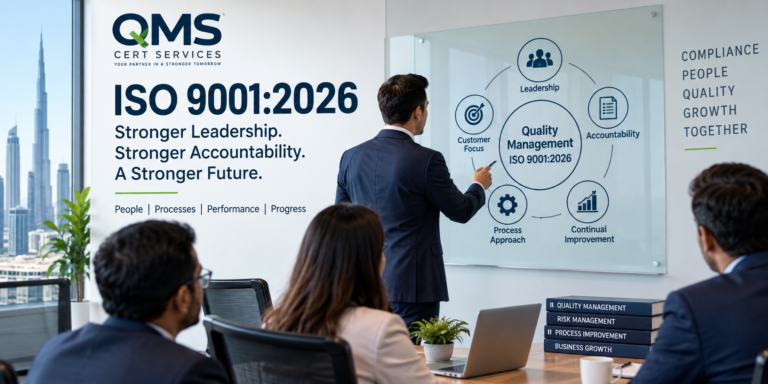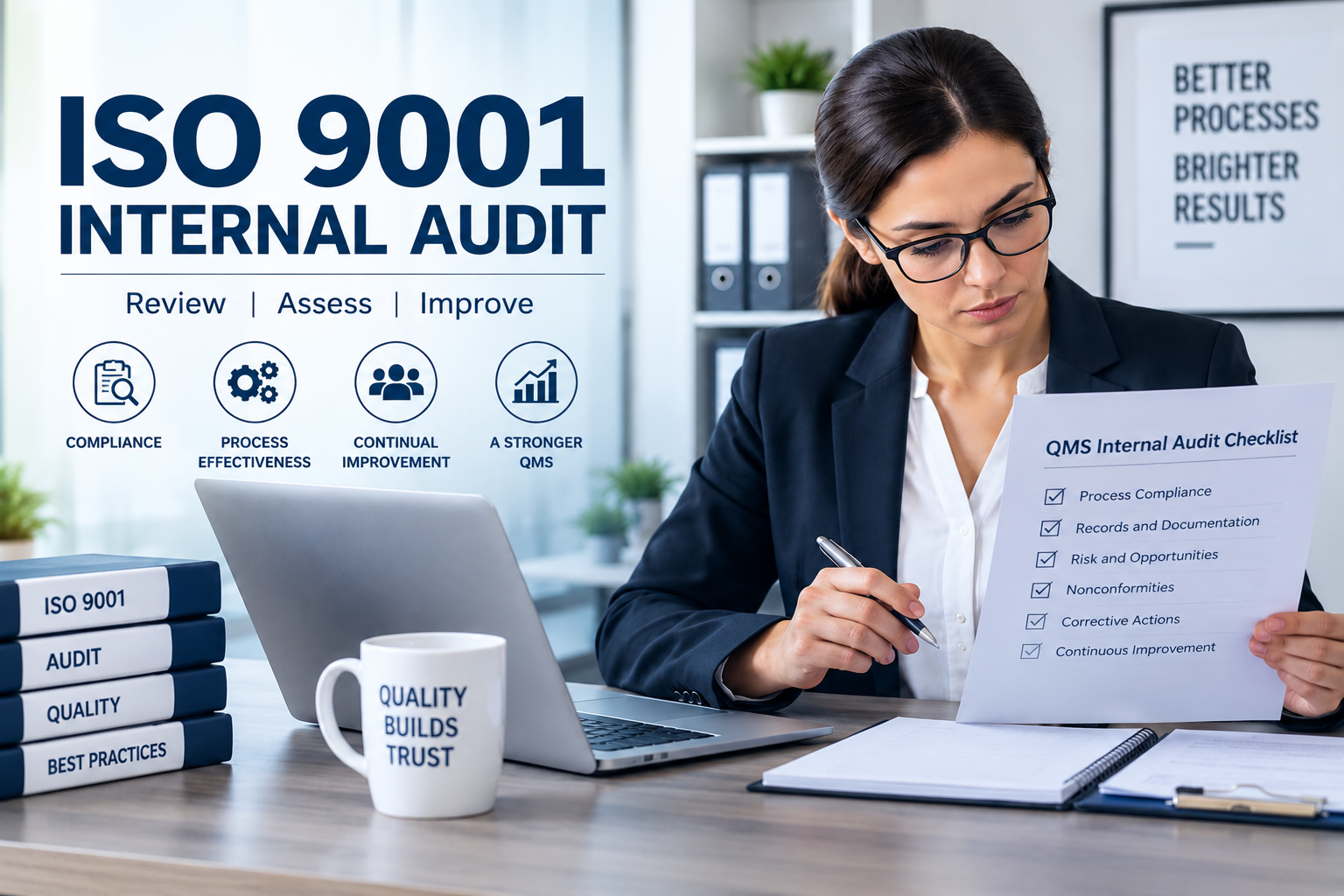
An ISO 9001 internal audit checklist helps organizations systematically evaluate whether their Quality Management System (QMS) is effectively implemented and meets applicable ISO 9001 requirements.
However, an internal audit should not be treated as a simple checklist exercise. A well-planned audit evaluates process effectiveness, risks, responsibilities, documented information, performance results, corrective actions, and opportunities for improvement.
This practical ISO 9001 internal audit guide and checklist will help organizations plan, conduct, report, and follow up internal audits more effectively. It can be used by internal auditors, quality professionals, process owners, and organizations preparing for ISO 9001 certification or surveillance audits.
Table of Contents
What Is an ISO 9001 Internal Audit?
An ISO 9001 internal audit is a systematic and independent review of an organization’s Quality Management System to determine whether processes conform to planned arrangements, the organization’s own QMS requirements, and applicable ISO 9001 requirements.
The audit also evaluates whether the QMS is effectively implemented and maintained. Rather than focusing only on documents and records, internal auditors should examine how processes actually operate, interview relevant personnel, review objective evidence, and identify areas where controls or performance can be improved.
Why Are Internal Audits Important for ISO 9001?
Internal audits help organizations verify whether their Quality Management System is functioning effectively and meeting established requirements. They provide an opportunity to identify weaknesses, process gaps, nonconformities, and potential risks before they affect product or service quality or are identified during an external audit.
Effective internal audits also support continual improvement by providing management with objective information about process performance and the effectiveness of existing controls. The results can be used to determine corrective actions, improve processes, strengthen the QMS, and support better decision-making.
ISO 9001 Internal Audit Requirements
ISO 9001 requires organizations to conduct internal audits at planned intervals to determine whether the Quality Management System conforms to the organization’s own requirements and the requirements of ISO 9001, and whether it is effectively implemented and maintained.
Under Clause 9.2, organizations are expected to establish an audit programme considering the importance of processes, changes affecting the organization, and results of previous audits. Each audit should have defined criteria and scope, and auditors should be selected to ensure objectivity and impartiality.
Audit results should be reported to relevant management, necessary corrections and corrective actions should be taken without undue delay, and documented information should be retained as evidence of the audit programme and audit results.
How to Plan an ISO 9001 Internal Audit
Effective internal auditing starts with proper planning. Before conducting an audit, the organization should clearly define the audit objective, scope, criteria, departments or processes to be audited, responsible auditor, and planned audit date.
The audit programme should consider the importance and performance of each process, previous audit results, identified risks, customer complaints, nonconformities, process changes, and other relevant factors. Processes with higher risks or recurring issues may require more frequent or detailed audits.
Auditors should also review relevant procedures, process documents, previous audit findings, corrective actions, performance indicators, and applicable ISO 9001 requirements before starting the audit. Good preparation allows the auditor to focus on meaningful evidence rather than simply completing a checklist.
ISO 9001 Internal Audit Checklist
A structured internal audit checklist helps auditors evaluate the Quality Management System consistently and ensures that important requirements are not overlooked. The checklist should be adapted to the organization’s processes, risks, scope, and QMS requirements rather than being used as a simple yes-or-no questionnaire.
The following practical checklist can be used as a starting point when conducting an ISO 9001 internal audit.
Context of the Organization
- Has the organization identified relevant internal and external issues that can affect the QMS?
- Have the needs and expectations of relevant interested parties been identified and reviewed?
- Is the scope of the Quality Management System clearly defined and maintained?
- Are the processes required for the QMS identified, including their inputs, outputs, sequence, interactions, responsibilities, and controls?
- Are relevant risks and opportunities associated with these processes considered?
- Are changes in the organization’s context periodically reviewed and reflected in the QMS where necessary?
Leadership
- Does top management demonstrate leadership and commitment to the effectiveness of the Quality Management System?
- Is the quality policy established, communicated, understood, and appropriate to the organization’s purpose and strategic direction?
- Are quality objectives aligned with the quality policy and organizational priorities?
- Are QMS requirements integrated into relevant business processes?
- Are responsibilities and authorities for relevant QMS roles clearly assigned and communicated?
- Does top management promote customer focus and ensure that customer and applicable statutory and regulatory requirements are understood and met?
- Does management support process owners and employees in contributing to the effectiveness and continual improvement of the QMS?
Planning
- Has the organization identified risks and opportunities that could affect the Quality Management System and its intended results?
- Are appropriate actions planned to address identified risks and opportunities?
- Are quality objectives established at relevant functions, levels, and processes?
- Are quality objectives measurable, monitored, communicated, and updated when necessary?
- Are responsibilities, required resources, timelines, and methods for evaluating quality objectives clearly defined?
- Are changes to the Quality Management System planned and implemented in a controlled manner?
- When planning QMS changes, does the organization consider the purpose of the change, potential consequences, available resources, and allocation of responsibilities?
Support
- Has the organization determined and provided the resources necessary to establish, implement, maintain, and continually improve the QMS?
- Are personnel performing work that affects quality competent based on appropriate education, training, skills, or experience?
- Is appropriate documented evidence of competence maintained?
- Are employees aware of the quality policy, relevant quality objectives, their contribution to QMS effectiveness, and the consequences of not conforming to QMS requirements?
- Are internal and external QMS communications appropriately determined and controlled?
- Is documented information properly created, reviewed, approved, updated, distributed, accessed, stored, protected, and retained?
- Are monitoring and measuring resources suitable for their intended purpose and calibrated or verified where required?
- Is organizational knowledge identified, maintained, and made available where necessary for effective process operation and product or service conformity?
Operation
- Are operational processes planned, implemented, and controlled to meet product and service requirements?
- Are customer requirements reviewed and confirmed before accepting orders or contracts?
- Are applicable statutory and regulatory requirements identified and considered?
- Where design and development is applicable, are activities properly planned, reviewed, verified, validated, and controlled?
- Are external providers and suppliers evaluated, selected, monitored, and periodically re-evaluated based on defined criteria?
- Are purchasing requirements clearly communicated to suppliers?
- Are production and service activities carried out under controlled conditions using appropriate documented information, equipment, monitoring, and competent personnel?
- Are product identification and traceability maintained where required?
- Is customer or external provider property properly identified, protected, and controlled?
- Are products and services adequately preserved during production, storage, handling, packaging, and delivery?
- Are product or service release activities performed by authorized personnel with appropriate evidence of conformity?
- Are nonconforming outputs identified, controlled, segregated where necessary, and appropriately dispositioned to prevent unintended use or delivery?
Performance Evaluation
- Has the organization determined what needs to be monitored and measured, including appropriate methods and frequency?
- Are process performance and product or service conformity regularly monitored and evaluated?
- Is customer satisfaction monitored using appropriate methods and relevant information?
- Are quality performance data and trends analyzed and evaluated to identify improvement opportunities?
- Are internal audits conducted at planned intervals according to an established audit programme?
- Are internal audit findings reported to relevant management and followed up appropriately?
- Are management reviews conducted at planned intervals?
- Does management review consider relevant inputs such as audit results, customer satisfaction, process performance, nonconformities, corrective actions, risks and opportunities, supplier performance, and achievement of quality objectives?
- Are management review decisions and actions documented and followed up?
Improvement
- Does the organization identify and implement opportunities to improve products, services, processes, and the effectiveness of the QMS?
- When a nonconformity occurs, does the organization take appropriate action to control and correct it and deal with its consequences?
- Is the root cause of significant or recurring nonconformities investigated to prevent recurrence?
- Are corrective actions appropriate to the effects and risks associated with the identified nonconformities?
- Is the effectiveness of corrective actions reviewed after implementation?
- Are risks and opportunities updated when necessary based on nonconformities and corrective actions?
- Is documented information retained as evidence of nonconformities, actions taken, and corrective action results?
- Does the organization continually improve the suitability, adequacy, and effectiveness of its Quality Management System?
How to Conduct an ISO 9001 Internal Audit
Conducting an effective ISO 9001 internal audit requires more than checking whether procedures and records exist. The auditor should evaluate how the process actually works, whether established controls are being followed, and whether the process is achieving its intended results.
The audit should begin with a brief opening discussion with the relevant process owner to confirm the audit scope, objectives, and activities to be reviewed. The auditor should then gather objective evidence through employee interviews, observation of activities, review of documents and records, and sampling of relevant transactions or outputs.
Audit evidence should be compared against defined audit criteria, including ISO 9001 requirements, internal procedures, customer requirements, and applicable statutory or regulatory requirements. Any identified nonconformity should be supported by clear objective evidence.
At the end of the audit, findings should be discussed with the responsible personnel and communicated clearly. The audit report should record relevant findings, conclusions, and required follow-up actions.
How to Report Internal Audit Findings
Internal audit findings should be reported clearly, objectively, and based on verifiable evidence. The report should help management and process owners understand what was reviewed, what was found, and what actions may be required.
Each nonconformity should clearly identify the applicable requirement, the objective evidence observed during the audit, and the specific gap between the requirement and actual practice. Auditors should avoid vague statements or personal opinions.
Audit findings may include nonconformities, observations, and opportunities for improvement, depending on the organization’s audit procedure. Positive practices and areas where processes are working effectively may also be recorded where appropriate.
The final audit report should include the audit scope, criteria, date, auditor, processes or departments audited, findings, audit conclusion, and any required corrective actions or follow-up activities. Audit results should be communicated to relevant management without unnecessary delay.
Corrective Action and Follow-Up After an Internal Audit
Internal audit findings should lead to appropriate action where gaps or nonconformities are identified. The responsible process owner should first take necessary correction to address the immediate issue and then determine whether corrective action is required to prevent recurrence.
For significant or recurring nonconformities, the organization should investigate the root cause rather than only correcting the visible problem. Appropriate actions should then be defined, assigned to responsible personnel, and completed within agreed timeframes.
Follow-up is an important part of the audit process. The auditor or designated responsible person should verify that actions have been implemented and evaluate whether they are effective in preventing recurrence. An audit finding should not be considered effectively closed simply because an action has been completed; objective evidence should demonstrate that the identified issue has been adequately addressed.
Records of corrections, root cause analysis, corrective actions, verification, and closure should be maintained as appropriate.
Common Internal Audit Mistakes to Avoid
Even experienced organizations can reduce the effectiveness of internal audits by treating them as a routine compliance exercise. Avoiding common audit mistakes helps ensure that internal audits provide meaningful information for improving the QMS.
- Using the same generic checklist for every department without considering process-specific risks and requirements.
- Auditing documents and records only, without observing actual activities or interviewing relevant personnel.
- Focusing only on finding nonconformities instead of evaluating process effectiveness and performance.
- Auditors reviewing their own work, which can affect objectivity and impartiality.
- Raising findings without sufficient objective evidence or a clearly defined requirement.
- Failing to investigate the root cause of recurring nonconformities.
- Closing corrective actions without verifying their effectiveness.
- Ignoring previous audit findings, customer complaints, process performance trends, and identified risks during audit planning.
- Conducting audits only shortly before an external certification or surveillance audit.
A strong internal audit programme should be risk-based, process-focused, objective, and used as a continual improvement tool rather than simply as preparation for a certification audit.
How Often Should ISO 9001 Internal Audits Be Conducted?
ISO 9001 does not prescribe a fixed frequency, such as requiring every process to be audited once per year. Instead, internal audits must be conducted at planned intervals based on the organization’s audit programme.
The frequency should consider factors such as the importance of the process, associated risks and opportunities, previous audit results, process performance, customer complaints, significant changes, and recurring nonconformities.
For example, a high-risk process with repeated quality issues may need to be audited more frequently, while a stable and consistently performing process may require less frequent auditing. Organizations should therefore establish an audit frequency that is appropriate to their operations and be able to justify the basis of their audit programme.
Benefits of an Effective ISO 9001 Internal Audit Programme
An effective internal audit programme provides value beyond simply demonstrating conformity with ISO 9001. It gives management a clearer understanding of how well the Quality Management System is performing and where improvements may be required.
Key benefits include:
- Identifying process gaps and weaknesses before they develop into significant quality problems.
- Detecting nonconformities before certification, surveillance, or customer audits.
- Improving process effectiveness and operational controls.
- Supporting risk-based thinking and early identification of potential issues.
- Strengthening corrective action and continual improvement activities.
- Improving employee awareness of QMS requirements and responsibilities.
- Providing management with objective information for decision-making.
- Helping improve customer satisfaction through better control of processes, products, and services.
When internal audits are properly planned and conducted, they become an important management tool for improving QMS performance rather than simply a requirement to be completed for ISO 9001 certification.
ISO 9001 Internal Audit FAQs
Is an internal audit mandatory for ISO 9001 certification?
Yes. Internal auditing is a requirement of ISO 9001. Clause 9.2 requires an organization to conduct internal audits at planned intervals to determine whether its Quality Management System conforms to applicable requirements and is effectively implemented and maintained.
For organizations seeking ISO 9001 certification, internal audits should be conducted as part of implementing and evaluating the QMS before the certification audit. Records of the audit programme and audit results should also be maintained as documented information.
Who can conduct an ISO 9001 internal audit?
An ISO 9001 internal audit can be conducted by competent personnel who have the necessary knowledge and skills to perform the audit effectively. The auditor may be an employee of the organization or, where appropriate, an external qualified professional.
The organization should select auditors in a way that ensures objectivity and impartiality throughout the audit process. Auditors should not audit their own work where this would compromise impartiality.
Internal auditors should understand the organization’s processes, relevant QMS requirements, audit principles, methods for collecting objective evidence, and how to report audit findings clearly and accurately.
What is the difference between an internal audit and a certification audit?
An internal audit is conducted by or on behalf of the organization to evaluate whether its Quality Management System conforms to established requirements and is effectively implemented and maintained. Its main purpose is to identify gaps, evaluate process effectiveness, and support continual improvement.
A certification audit, on the other hand, is conducted by an independent certification body to determine whether the organization’s QMS conforms to ISO 9001 requirements for the purpose of certification or maintaining an existing certification.
Internal audit results remain an important input for certification preparation because they help organizations identify and address potential nonconformities before the external certification audit.
How long does an ISO 9001 internal audit take?
The duration of an ISO 9001 internal audit depends on several factors, including the size of the organization, number and complexity of processes, QMS scope, number of locations, associated risks, and previous audit results.
A small organization with a limited number of processes may complete an internal audit within a day, while a larger or more complex organization may require several days or a planned audit programme spread across different dates.
The audit duration should provide sufficient time to collect appropriate objective evidence and evaluate process effectiveness. Organizations should avoid reducing audit time simply to complete the audit quickly, as this can limit the effectiveness and value of the audit.
Can an organization use an external consultant to conduct internal audits?
Yes. An organization can use a competent external consultant or auditor to conduct its ISO 9001 internal audits. This can be particularly useful when the organization does not have sufficiently trained internal auditors, requires additional expertise, or wants greater independence in evaluating its Quality Management System.
The organization should ensure that the external auditor is competent and that objectivity and impartiality are maintained throughout the audit process. The audit scope, criteria, responsibilities, reporting requirements, and confidentiality arrangements should also be clearly defined.
Using an external auditor does not transfer responsibility for the QMS to the consultant. The organization remains responsible for its Quality Management System and for ensuring that identified findings and corrective actions are appropriately addressed.
Need Help with ISO 9001 Internal Audits?
Conducting an effective internal audit requires the right combination of ISO 9001 knowledge, audit competence, process understanding, and objective evaluation.
QMS Cert Services supports organizations with ISO 9001 internal audits, gap assessments, QMS implementation, documentation, corrective action support, and certification readiness. Our approach focuses not only on identifying compliance gaps but also on helping organizations strengthen their processes and improve the effectiveness of their Quality Management System.
If your organization needs support with an ISO 9001 internal audit or wants to assess its readiness before a certification or surveillance audit, contact QMS Cert Services for professional assistance.
Conclusion
An effective ISO 9001 internal audit is more than a compliance requirement. It is a practical tool for evaluating process performance, identifying risks and weaknesses, verifying the effectiveness of controls, and driving continual improvement within the Quality Management System.
Organizations should plan internal audits based on process importance, risks, previous audit results, and changes affecting the QMS. Audit findings should be supported by objective evidence, followed by appropriate corrective actions, and verified for effectiveness.
By using a structured and process-focused internal audit approach, organizations can strengthen their QMS, reduce recurring problems, improve overall performance, and be better prepared for certification and surveillance audits.