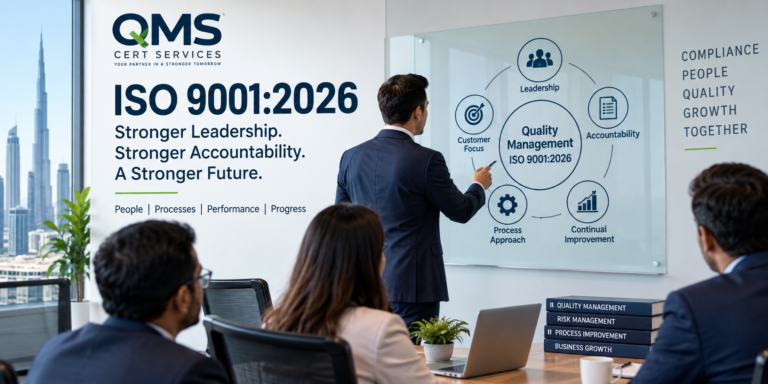
ISO 9001 is evolving from the 2015 edition to ISO 9001:2026, bringing targeted updates designed to keep the Quality Management System (QMS) standard relevant to today’s business environment.
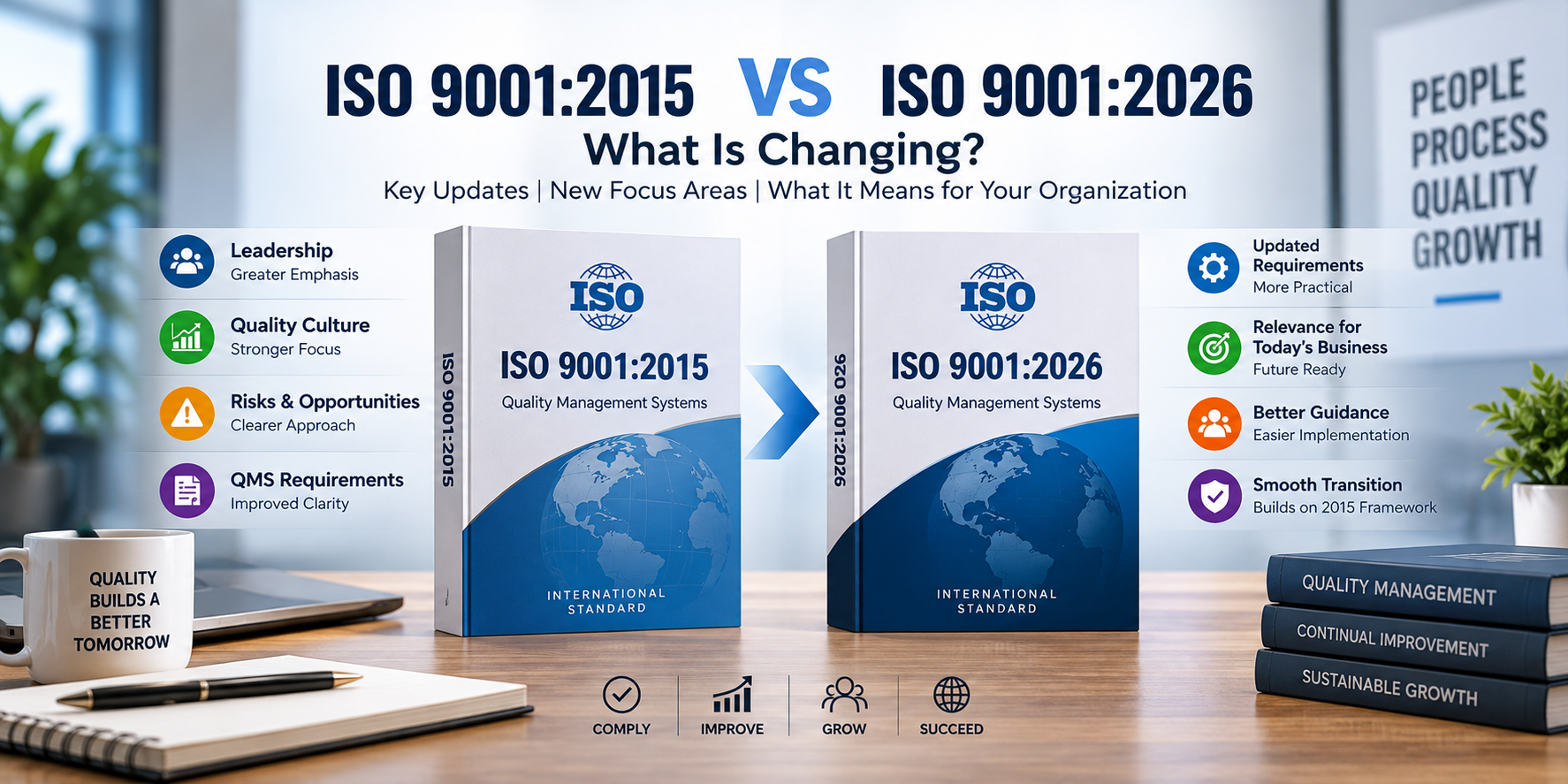
The ISO 9001 changes do not represent a complete redesign of the standard. Instead, the revised edition builds on the established ISO 9001:2015 framework while introducing clearer requirements and greater emphasis on areas such as leadership, quality culture, risks and opportunities.
For organizations currently certified to ISO 9001:2015, understanding the differences between the two editions is essential for planning an effective transition without making unnecessary changes to an existing QMS.
Table of Contents
ISO 9001:2015 vs ISO 9001:2026: What Is Changing?
ISO 9001:2026 retains the core Quality Management System principles and overall structure familiar to organizations using ISO 9001:2015.
The revision focuses on targeted improvements rather than requiring organizations to rebuild their Quality Management Systems from the beginning.
Important ISO 9001 changes include clearer requirements, stronger emphasis on leadership and quality culture, greater clarity around risks and opportunities, and additional guidance intended to support consistent understanding and implementation.
Organizations with a mature ISO 9001:2015 system should therefore focus on identifying specific gaps between their existing QMS and the revised requirements rather than rewriting every procedure and document.
Why Is ISO 9001 Being Revised?
ISO 9001 is periodically reviewed to ensure that it remains relevant to organizations operating in changing business environments.
Since ISO 9001:2015 was published, organizations have experienced significant developments in technology, digitalization, supply chains, customer expectations, sustainability considerations and organizational risk.
The revision aims to improve the clarity and usability of the standard while maintaining the established Quality Management System framework that organizations already understand.
The objective is not simply to introduce new requirements, but to ensure that ISO 9001 continues to support effective quality management, customer satisfaction and continual improvement in modern organizations.
For official information and updates about the ISO 9001 revision, refer to the International Organization for Standardization (ISO).
Key ISO 9001 Changes from 2015 to 2026
1. Stronger Emphasis on Leadership
ISO 9001:2015 already requires top management to demonstrate leadership and commitment to the Quality Management System. ISO 9001:2026 strengthens the emphasis on leadership involvement, accountability and the role of management in developing an effective quality culture.
Top management should ensure that quality objectives support the organization’s strategic direction, appropriate resources are available and QMS requirements are integrated into normal business processes.
Quality should not be treated solely as the responsibility of the Quality Manager or Quality Department. Leadership involvement should be visible throughout the organization and support continual improvement and customer-focused performance.
2. Greater Focus on Quality Culture
Quality culture receives greater attention in ISO 9001:2026. An effective Quality Management System depends not only on procedures and records but also on how people throughout the organization understand and apply quality principles in their daily work.
Organizations should encourage employees to take responsibility for quality, follow established processes, report problems, identify improvement opportunities and understand how their work affects customers and organizational performance.
Management should also create an environment where quality issues can be raised openly and corrective actions focus on preventing recurrence rather than simply closing findings.
A strong quality culture helps integrate the QMS into everyday business activities instead of treating ISO 9001 primarily as a certification requirement.
3. Clearer Approach to Risks and Opportunities
Risk-based thinking remains an important part of ISO 9001, but ISO 9001:2026 provides greater clarity around the treatment of risks and opportunities.
Organizations should identify risks that could negatively affect QMS performance as well as opportunities that could improve processes, products, services or customer satisfaction.
Examples of quality-related risks may include supplier failures, process variation, equipment breakdown, inadequate competence, inspection failures and recurring customer complaints.
Opportunities may include automation, digitalization, supplier development, improved inspection methods, employee training and process optimization.
The focus should be on practical actions and effective decision-making rather than creating unnecessary risk documentation only for audit purposes.
4. Improved Clarity of Requirements
One of the important ISO 9001 changes is improved clarity in the wording and interpretation of requirements.
Clearer requirements can help reduce inconsistent interpretations between organizations, consultants, internal auditors and certification auditors.
Organizations should continue to apply ISO 9001 requirements according to their own context, processes, products, services and associated risks.
The objective is not for every organization to operate an identical Quality Management System, but to establish controls that are appropriate, effective and capable of consistently achieving intended quality results.
5. New Annex A for Additional Guidance
ISO 9001:2026 introduces a new Annex A to provide additional clarification on important terminology and the intent behind certain requirements.
This guidance is intended to help organizations, Quality Managers and auditors develop a more consistent understanding of how particular requirements should be interpreted and applied.
The additional clarification can be especially useful when organizations conduct gap analyses, update their existing Quality Management Systems or prepare for transition audits.
Organizations should use the guidance to support practical implementation while ensuring that their QMS remains appropriate to their own processes, risks and operating environment.
ISO 9001:2015 vs ISO 9001:2026 Comparison
| Comparison Area | ISO 9001:2015 | ISO 9001:2026 | Key Change | What Organizations Should Do |
| Leadership | Leadership and commitment required | Stronger emphasis on leadership involvement and accountability | Increased leadership focus | Review management involvement in QMS |
| Quality Culture | Indirectly supported through QMS requirements | Greater emphasis on quality culture | Stronger organizational quality mindset | Promote quality responsibility across all levels |
| Risks & Opportunities | Risk-based thinking introduced | Greater clarity around risks and opportunities | Clearer practical application | Review risk and opportunity management |
| Requirements | Established QMS requirements | Improved clarity and interpretation | Clearer requirements | Conduct a gap analysis against the revised edition |
| Guidance | Supporting guidance included | New Annex A provides additional clarification | More implementation guidance | Review Annex A when updating the QMS |
What Will Remain the Same in ISO 9001:2026?
Despite the ISO 9001 changes, the fundamental approach to Quality Management Systems remains consistent.
Organizations can continue using the core elements of their existing QMS, including the process approach, customer focus, documented information, competence management, operational controls, performance monitoring, internal audits, management reviews, corrective actions and continual improvement.
Organizations with a well-established ISO 9001:2015 system should therefore avoid making unnecessary changes. The priority should be to evaluate the revised requirements, identify relevant gaps and update only the processes and controls that require improvement.
This approach can make the transition more efficient while maintaining the effectiveness and stability of the existing Quality Management System.
How Will ISO 9001:2026 Affect Existing Certified Organizations?
Organizations currently certified to ISO 9001:2015 should evaluate how the ISO 9001 changes affect their existing Quality Management System and identify any gaps against the revised requirements.
For organizations with a mature and effectively implemented QMS, many existing processes and controls are expected to remain applicable. The main task will be to identify where updates or additional improvements are required.
Organizations should conduct a structured gap analysis, review affected processes and documented information, communicate relevant changes to employees and ensure that internal auditors and process owners understand the revised requirements.
Certification arrangements and applicable transition requirements should also be confirmed with the organization’s certification body once the final transition guidance is available.
How to Prepare for the ISO 9001:2026 Transition
Organizations should begin preparing for the ISO 9001 changes in a structured way rather than waiting until their next certification audit.
Start by reviewing the revised ISO 9001 requirements and conducting a gap analysis against the existing Quality Management System. This will help identify which processes, controls or documented information may require updates.
Organizations should then develop an action plan with clear responsibilities and target dates. Process owners, internal auditors and relevant employees should be trained or briefed on the changes that affect their responsibilities.
Internal audits should verify whether the updated requirements have been effectively implemented, while management review should evaluate transition progress, identified risks and any additional resources required.
Early preparation can reduce last-minute corrective actions and support a smoother transition from ISO 9001:2015 to ISO 9001:2026.
Common Mistakes to Avoid During the ISO 9001:2026 Transition
Organizations should avoid making unnecessary changes to their entire Quality Management System while responding to the ISO 9001 changes introduced in the revised edition.
Common transition mistakes include rewriting procedures without first conducting a gap analysis, focusing only on documentation instead of actual process effectiveness, and failing to involve top management and process owners.
Organizations should also avoid delaying employee awareness, internal auditor training and implementation activities until immediately before a certification audit.
Another mistake is treating every change as a mandatory new document or procedure. The organization should first understand the requirement, evaluate its existing controls and determine whether an actual gap exists.
A planned, evidence-based transition approach can reduce unnecessary work and help maintain the effectiveness of the existing QMS.
ISO 9001:2026 Frequently Asked Questions
1. When will ISO 9001:2026 be published?
ISO 9001:2026 is scheduled for publication on 16 September 2026. It will replace ISO 9001:2015 as the latest edition of the international Quality Management System standard. Organizations should follow official ISO updates and guidance from their certification bodies regarding the applicable transition arrangements.
2. Is ISO 9001:2026 completely different from ISO 9001:2015?
No. ISO 9001:2026 is not a complete replacement of the existing Quality Management System framework. It builds on ISO 9001:2015 and introduces targeted updates, clearer requirements and greater emphasis on areas such as leadership, quality culture, risks and opportunities.
Organizations with an effectively implemented ISO 9001:2015 QMS should therefore focus on identifying and addressing relevant gaps rather than rebuilding their entire management system.
3. Do organizations need to rewrite all QMS documents for ISO 9001:2026?
No. Organizations should not automatically rewrite all QMS documents when transitioning to ISO 9001:2026.
The better approach is to conduct a gap analysis and identify which existing processes, procedures, records or controls are affected by the revised requirements.
Documents should be updated only where necessary to address identified gaps, improve clarity or ensure effective implementation. This helps avoid unnecessary documentation and keeps the Quality Management System practical and efficient.
4. Should organizations conduct a gap analysis before transitioning to ISO 9001:2026?
Yes. A gap analysis is one of the most effective ways to prepare for the transition to ISO 9001:2026.
It helps organizations compare their existing ISO 9001:2015 Quality Management System against the revised requirements and identify areas that may require improvement.
The results can then be used to develop a structured transition action plan, assign responsibilities, update affected processes and verify implementation through internal audits.
How QMS Cert Services Can Support Your ISO 9001:2026 Transition
QMS Cert Services supports organizations in preparing for the transition from ISO 9001:2015 to ISO 9001:2026 through a practical and structured approach.
Our support can include ISO 9001 gap analysis, QMS documentation review, process assessment, risk and opportunity evaluation, internal audit support, corrective action guidance, management review preparation and transition readiness assessment.
The objective is to identify actual gaps, avoid unnecessary changes and help organizations strengthen their existing Quality Management System in line with the revised requirements.
For ISO 9001:2026 transition support, contact QMS Cert Services to discuss your organization’s requirements.
Conclusion
The ISO 9001 changes from ISO 9001:2015 to ISO 9001:2026 represent an evolution of the existing Quality Management System framework rather than a complete redesign.
The key ISO 9001 changes place greater emphasis on leadership, quality culture, risks and opportunities, and clearer interpretation of requirements while maintaining the fundamental principles organizations already use.
Organizations should focus on understanding the revised requirements, conducting a structured gap analysis and updating only those areas where genuine gaps are identified.
Early and systematic preparation can help organizations achieve a smoother transition while continuing to improve QMS effectiveness, customer satisfaction and overall quality performance.