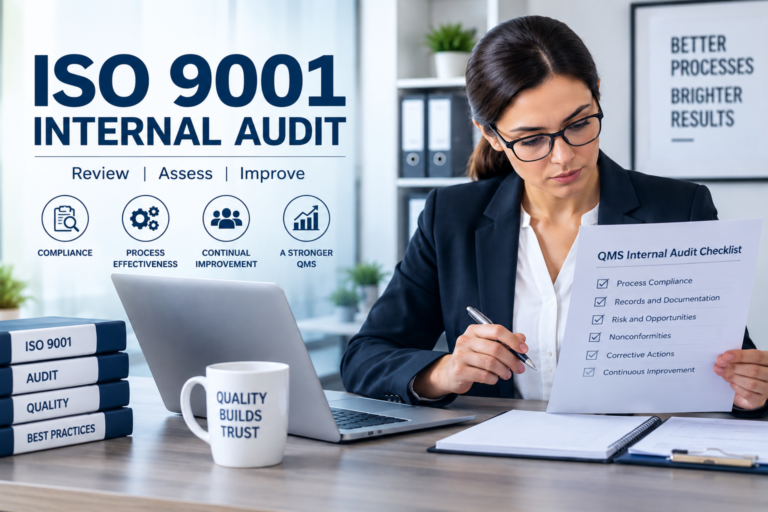
ISO 9001 certification helps organizations improve process control, customer satisfaction, operational consistency and overall quality performance.
Many companies in the UAE require ISO 9001 certification to meet customer expectations, qualify for tenders, improve internal systems or demonstrate their commitment to quality.
However, organizations often feel confused about the certification process, required documents, implementation timeline and audit stages.
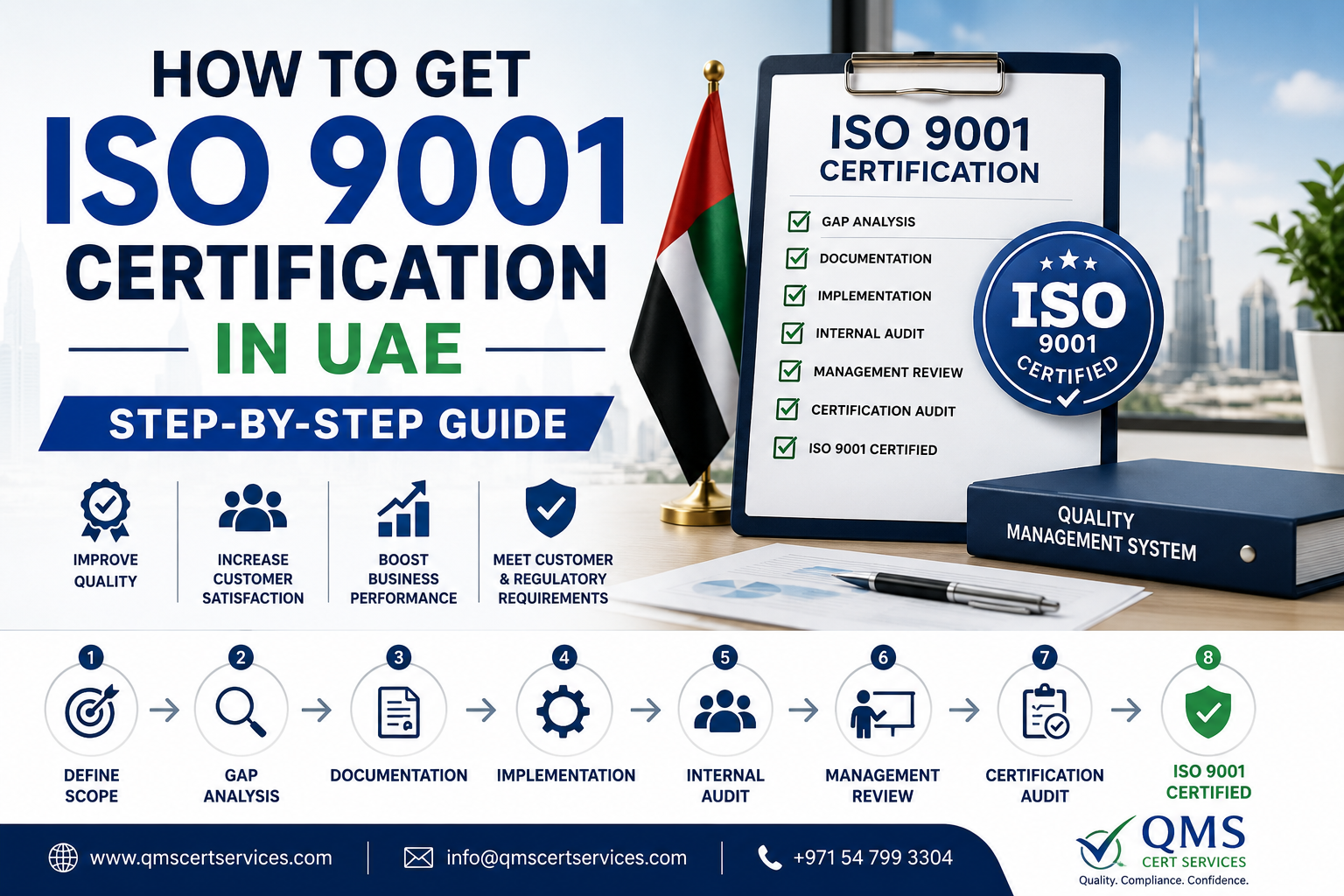
This guide explains the complete ISO 9001 certification process in simple steps.
What Is ISO 9001 Certification?
ISO 9001 is an internationally recognized quality management system standard.
It provides a structured framework to help organizations:
✅ Improve the consistency of products and services
✅ Define responsibilities and processes
✅ Control documents and records
✅ Manage risks and opportunities
✅ Monitor customer satisfaction
✅ Reduce errors and repeated problems
✅ Improve business performance
✅ Support continual improvement
ISO 9001 can be implemented by organizations of any size and industry, including manufacturing, construction, trading, logistics, healthcare, engineering, service companies and professional organizations.
Step 1: Define the Scope of the Quality Management System
The first step is to define the scope of the ISO 9001 quality management system.
The scope explains which business activities, departments, locations, products and services will be covered by the certification.
The organization should consider:
✅ Main business activities
✅ Products and services
✅ Departments involved
✅ Office, factory or project locations
✅ Customer and regulatory requirements
✅ Processes included in the system
A clear scope helps prevent confusion during implementation and certification audits.
Example:
“Provision of mechanical fabrication, installation and maintenance services in the UAE.”
The scope should accurately reflect the actual activities of the organization.
Step 2: Conduct an ISO 9001 Gap Analysis
A gap analysis compares the organization’s existing system with the requirements of ISO 9001.
It helps identify what is already available and what still needs to be developed or improved.
The gap analysis normally reviews:
🔍 Organizational context
🔍 Interested parties
🔍 Quality policy
🔍 Quality objectives
🔍 Roles and responsibilities
🔍 Risks and opportunities
🔍 Operational controls
🔍 Supplier control
🔍 Customer requirements
🔍 Internal audit
🔍 Management review
🔍 Corrective actions
🔍 Document and record control
The gap-analysis report should clearly list findings, required actions, responsible persons and target completion dates.
A proper gap analysis can save time and reduce major issues later in the certification process.
Step 3: Develop the Required ISO 9001 Documentation
The organization must develop documents and records suitable for its activities.
ISO documentation should not be unnecessarily complicated. It should be practical, clear and easy for employees to follow.
Common ISO 9001 documents include:
📄 Quality policy
📄 Quality objectives
📄 Quality management system scope
📄 Process interaction map
📄 Risk and opportunity register
📄 Organization chart
📄 Roles and responsibilities
📄 Document-control procedure
📄 Internal-audit procedure
📄 Corrective-action procedure
📄 Supplier-evaluation process
📄 Customer-complaint process
📄 Training and competency records
📄 Inspection or service records
📄 Management-review records
The documents should match the organization’s actual working practices.
Documents created only for audit purposes may result in nonconformities if employees do not follow them.
Step 4: Implement the Quality Management System
After the documents are prepared, the organization must implement the system across relevant departments.
Implementation means employees must follow the approved processes and maintain records as evidence.
Important implementation activities include:
✅ Communicating the quality policy
✅ Assigning process responsibilities
✅ Following approved procedures
✅ Maintaining required records
✅ Monitoring quality objectives
✅ Evaluating suppliers
✅ Recording customer complaints
✅ Controlling nonconforming outputs
✅ Taking corrective actions
✅ Reviewing risks and opportunities
✅ Monitoring process performance
The certification auditor will verify whether the system is actually working, not only whether documents are available.
Step 5: Provide ISO Awareness Training
Employees should understand how ISO 9001 applies to their work.
Training should be provided based on the employee’s role and responsibilities.
Employees may need awareness about:
👥 Quality policy
👥 Quality objectives
👥 Department procedures
👥 Customer requirements
👥 Risks related to their work
👥 Record-keeping requirements
👥 Reporting of problems
👥 Corrective actions
👥 Continual improvement
During the certification audit, employees may be interviewed.
They should be able to explain their responsibilities and show relevant records.
Step 6: Maintain Implementation Records
Records provide evidence that the quality management system is being implemented.
Common records may include:
📋 Training records
📋 Supplier evaluations
📋 Purchase approvals
📋 Inspection reports
📋 Customer-feedback records
📋 Complaint records
📋 Calibration records
📋 Maintenance records
📋 Risk-review records
📋 Corrective-action reports
📋 Internal-audit reports
📋 Management-review minutes
Records should be complete, approved, traceable and properly controlled.
Missing or incomplete records are a common reason for audit findings.
Step 7: Conduct the Internal Audit
An internal audit must be completed before the certification audit.
The internal audit checks whether the organization’s system:
✅ Meets ISO 9001 requirements
✅ Follows internal procedures
✅ Is properly implemented
✅ Is achieving planned results
✅ Has effective process controls
The internal audit should cover all relevant departments and processes.
Internal auditors should be competent and should not audit their own work where possible.
Any findings should be documented and corrected before the certification audit.
Step 8: Conduct the Management Review
Top management must review the performance and effectiveness of the quality management system.
The management review normally includes:
✅ Internal-audit results
✅ Customer feedback
✅ Quality objectives
✅ Process performance
✅ Nonconformities
✅ Corrective actions
✅ Supplier performance
✅ Risks and opportunities
✅ Resource requirements
✅ Improvement opportunities
The meeting should result in clear decisions and actions.
Minutes of the management review should include responsibilities and target dates.
Step 9: Close Nonconformities and Corrective Actions
All major gaps identified during implementation and internal audit should be corrected.
A proper corrective-action process should include:
🔍 Problem description
🔍 Immediate correction
🔍 Root-cause analysis
🔍 Corrective action
🔍 Responsible person
🔍 Target date
🔍 Effectiveness verification
Simply fixing the immediate issue is not enough.
The organization should identify and eliminate the root cause to prevent recurrence.
Step 10: Select a Certification Body
The organization must select a competent and recognized certification body.
Before selecting a certification body, check:
✅ Accreditation status
✅ Experience in your industry
✅ Audit cost
✅ Audit duration
✅ Certification cycle
✅ Auditor availability
✅ Scope coverage
✅ Surveillance-audit requirements
✅ Customer or tender requirements
A consultancy company helps the organization prepare the system, while the certification body conducts the independent certification audit.
These two roles should remain separate.
Step 11: Complete the Stage 1 Audit
The Stage 1 audit is the initial review of the organization’s readiness.
The auditor normally checks:
📄 Scope of certification
📄 Organization details
📄 Management-system documents
📄 Process structure
📄 Internal-audit completion
📄 Management-review completion
📄 Level of implementation
📄 Readiness for Stage 2
The auditor may identify areas that need correction before the Stage 2 audit.
The organization should close these concerns before proceeding.
Step 12: Complete the Stage 2 Certification Audit
The Stage 2 audit is the main certification audit.
The auditor checks whether the quality management system is effectively implemented.
The audit may include:
🔍 Employee interviews
🔍 Department audits
🔍 Process observations
🔍 Record verification
🔍 Customer-requirement checks
🔍 Supplier-control checks
🔍 Inspection and service controls
🔍 Corrective-action effectiveness
🔍 Management involvement
🔍 Continual-improvement activities
If nonconformities are identified, the organization must submit corrective actions within the required timeline.
Step 13: Receive ISO 9001 Certification
After successful completion of the audit and closure of nonconformities, the certification body reviews the audit results.
Once approved, the organization receives its ISO 9001 certificate.
The certificate normally includes:
✅ Organization name
✅ Certified location
✅ Certification scope
✅ ISO standard
✅ Certificate number
✅ Issue date
✅ Expiry date
✅ Certification-body details
The organization should verify that all information on the certificate is correct.
Step 14: Maintain the ISO 9001 System
ISO 9001 certification is not a one-time activity.
The organization must continue to maintain and improve the system.
Important ongoing activities include:
✅ Conducting internal audits
✅ Completing management reviews
✅ Monitoring quality objectives
✅ Reviewing risks and opportunities
✅ Evaluating suppliers
✅ Reviewing customer feedback
✅ Closing corrective actions
✅ Updating documents
✅ Training employees
✅ Preparing for surveillance audits
The certification body normally conducts surveillance audits during the certification cycle.
Failure to maintain the system can result in nonconformities, suspension or withdrawal of certification.
How Long Does ISO 9001 Certification Take in the UAE?
The implementation timeline depends on:
⏳ Organization size
⏳ Number of employees
⏳ Number of locations
⏳ Complexity of processes
⏳ Existing documentation
⏳ Employee availability
⏳ Management support
⏳ Readiness for internal audit
A small organization with an existing management system may complete the process faster than a large organization with multiple departments and locations.
The system should not be rushed only to meet an audit date.
Sufficient implementation records should be available before the certification audit.
What Is the Cost of ISO 9001 Certification in the UAE?
The total cost may include:
💰 Consultancy support
💰 Documentation development
💰 Employee training
💰 Internal audit
💰 Certification-body audit
💰 Travel expenses, if applicable
💰 Surveillance audits
💰 Recertification audit
The cost depends on the organization’s size, scope, number of locations, employee count and process complexity.
Organizations should request a detailed quotation and confirm what is included.
Common Mistakes to Avoid
Organizations should avoid these common mistakes:
❌ Purchasing ready-made documents without customization
❌ Scheduling the certification audit too early
❌ Keeping documents without implementation
❌ Ignoring employee awareness
❌ Conducting incomplete internal audits
❌ Missing management review
❌ Keeping corrective actions open
❌ Selecting a certification body only based on low price
❌ Failing to maintain records
❌ Treating ISO as only a certificate
ISO 9001 should support real business improvement, not only audit compliance.
Benefits of ISO 9001 Certification
ISO 9001 certification can help an organization:
✅ Improve customer confidence
✅ Increase tender eligibility
✅ Standardize business processes
✅ Reduce errors and rework
✅ Improve supplier control
✅ Strengthen responsibilities
✅ Improve record management
✅ Monitor business performance
✅ Support continual improvement
✅ Build a stronger professional image
The actual benefits depend on how effectively the system is implemented and maintained.
Start with a Free ISO Readiness Assessment
Before starting the certification process, it is useful to understand the organization’s current readiness level.
QMS Cert Services provides a Free ISO Readiness Assessment to help identify:
🔍 Documentation gaps
🔍 Implementation weaknesses
🔍 Internal-audit gaps
🔍 Management-review gaps
🔍 Corrective-action gaps
🔍 Priority actions before certification
Start your Free ISO Readiness Assessment:
How QMS Cert Services Can Support Your Organization
QMS Cert Services provides professional ISO and management-system consultancy support in the UAE.
Our services include:
✅ ISO 9001 gap analysis
✅ Quality management system documentation
✅ ISO implementation support
✅ Employee awareness training
✅ Internal audit
✅ Management-review support
✅ Corrective-action support
✅ Certification-audit preparation
✅ Post-certification system improvement
Our approach is practical and based on the organization’s actual processes, risks and business requirements.
Contact QMS Cert Services
Email: info@qmscertservices.com
Phone: +971 54 799 3304
Location: Ajman, UAE
Website: https://qmscertservices.com/